This note summarises how open-source status varies across the AI tech and sector in The Social Good AI Hub. Of the 483 use cases in the Hub, 301 disclose whether their underlying AI is open source or proprietary, and 38% (117) of those are open source.
Key Findings
The Hub’s use cases cluster into a few recognisable functional types, and chatbots dominate. Chatbots and conversational assistants are the single largest group, at 100 of 301 use cases, roughly a third of everything in the Hub. Tutoring and adaptive-learning platforms follow (56), then diagnostic and screening tools (44), with a long tail of smaller categories after that. The sector concentrates heavily in a handful of tool types. There is however no meaningful concentration of open source use cases within these groups.
Open source use cases in the Hub are present across AI technologies and domains. However, Deep Learning, models trained for a single task such as reading a satellite image or predicting a crop yield, is open more often than use cases using large language models (LLMs) such as the GPT, Gemini, and Claude-style systems that now power most tools and chatbots. 51% of use cases using Deep Learning tech are open source, compared to 35% of use cases using LLMs.
What the data shows
Figure 1 shows each tool type and how open it is. Tools cluster clearly by function: a large head of chatbots, tutoring platforms, and diagnostic tools, then a long tail. Openness does not follow the same pattern. It varies only modestly across the common types, from about a quarter of chatbots (25%) to just over half of monitoring tools (56%). The smaller categories hold too few tools to draw much from. No single tool type stands out as the sector’s open-source cluster.
Figure 1: Open-source status by use case types
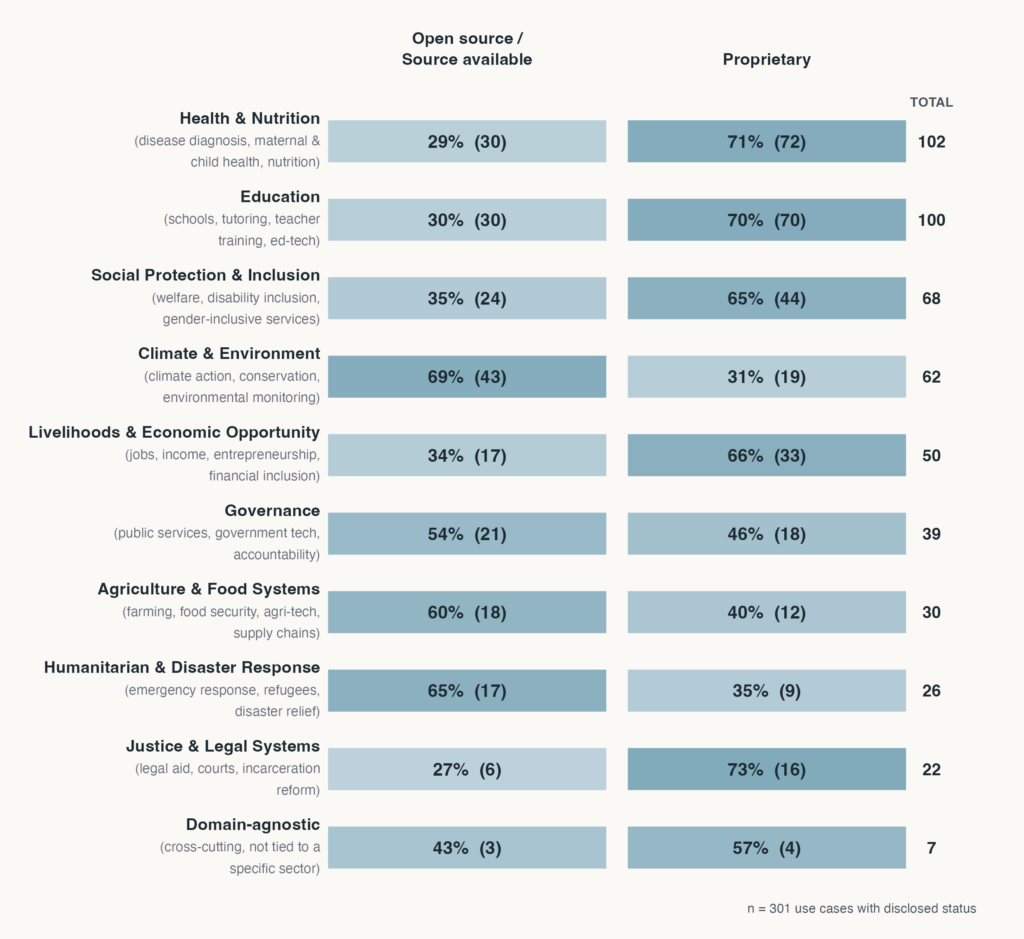
Figure 2 groups use cases by the kind of AI tech they are based on, and here a pattern does appear. Deep learning is open most often (51%); LLMs, which power most tools in the Hub, are open least often (35%) and are also the largest group by far (182 of 301 use cases). Classical ML sits in between (41%). One caution: this is about rate, not volume. Because LLMs are so common, they still produce more open tools in raw numbers than deep learning does (64 versus 35), and a meaningful share of LLM-based tools are open.
Figure 2: Open-source status by the kind of model a tool uses (AI paradigm)
We also observe a similar pattern when we group the use cases by domain/sector. As shown in Figure 3, the most open sectors, climate and environment (69% open), humanitarian and disaster response (65%), agriculture (60%), and governance (54%), lead the Hub. Climate and agriculture explain much of this: organisations here build their own deep-learning models on satellite imagery and sensor data, rather than wrapping an LLM. Humanitarian and governance reach similar levels for other reasons, which is worth exploring further.
Figure 3: Open-source status by domain/sector